
What is Monacolin K? What's new in the world of integration
For years it represented a valid support for those who could not keep their cholesterol under control but did not need statins or did not want to take them. Today, however, monacolin K can no longer be used as it was in the past: the European Food Safety Authority (EFSA) has decided that the allowed dosages in supplements were too high for a substance that acts effectively as a drug. That is why, from now on, dietary supplements may only provide doses lower than 3 mg per day of total monacolins.
Cholesterol and health Cholesterol
is an extremely important molecule for health; it is a fundamental component of cell membranes and the precursor of several substances essential for the proper functioning of the body – for example, steroid hormones (such as estrogens and cortisol), or vitamin D. Given its importance, it is not surprising that the liver can synthesize it. Unfortunately, however, excessively high cholesterol levels are a risk factor for cardiovascular diseases. In particular, cholesterol contained within low-density lipoproteins (LDL) can deposit in artery walls, contributing to atherosclerosis and thus increasing the risk of events like strokes and heart attacks. To maintain total and LDL cholesterol levels within normal ranges, it is first necessary to act on one’s diet. Contrary to what one might think, the foods to consume sparingly are not so much those containing cholesterol itself, but those containing trans fats (such as some old margarines) and those rich in saturated fats.
These fats are particularly abundant in animal-based foods generally used as protein sources, such as processed meats, milk, and cheese. Replacing their consumption with leaner or lower saturated fat protein sources (for example, blue fish, a source of Omega-3 polyunsaturated fats) can help bring cholesterol back to normal. Sometimes, however, dietary changes are not enough. In these cases, before moving on to drugs, it may be useful to try dietary supplements.
What is Monacolin K?
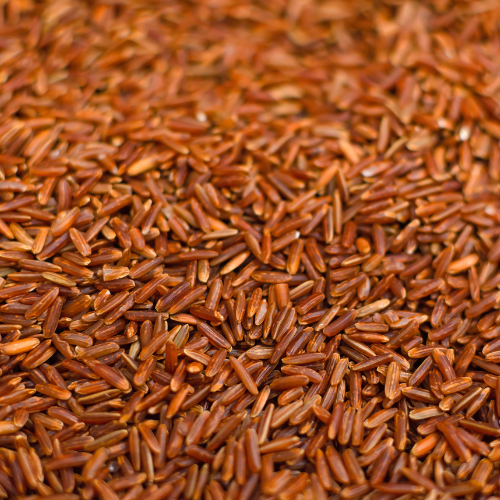
Monacolin K is the most abundant of the monacolins obtained from fermenting rice with yeasts, particularly Monascus purpureus; for this reason, supplements containing it are often called “red yeast rice” supplements.
In China, this red yeast rice has traditionally been used both as a food coloring and as a remedy for poor digestion and to promote good blood circulation. Its use as a food coloring is not authorized in the European Union; however, supplements containing it have been marketed for decades.
From a chemical point of view, the form of monacolin K present in red yeast rice (lactone) is practically identical to lovastatin, a molecule belonging to the most used drugs in managing high cholesterol: the statins. Given this high similarity, the success of monacolin K-based supplements against high cholesterol is not surprising. Until recently, EFSA authorized the use of the claim that «monacolin K from red yeast rice contributes to maintaining normal blood cholesterol levels».
With a warning: only products with a daily dosage of 10 mg of monacolin K could bear this statement, along with the clarification that to obtain monacolin K benefits, 10 mg must be taken daily. Unfortunately, however, the similarity between monacolin K and lovastatin is so high that it brings not only the desired cholesterol-lowering effects but also undesired ones. Indeed, like statins, monacolin K can cause side effects such as muscle pain and injury. Moreover, the safety of other monacolins present alongside monacolin K in red yeast rice products has not yet been established.
The new EFSA opinion
Already in 2013, a scientific evaluation by German authorities concluded that red yeast rice was not safe for food consumption. Then in 2016, the Belgian Superior Health Council highlighted subpopulations for whom the use of monacolin K could have contraindications: pregnant women, people with liver, kidney, or muscle disorders, children, adolescents, and the elderly over 70. This was followed in 2018 by EFSA’s scientific opinion on monacolin safety in red yeast rice, stating that taking red yeast rice supplements could lead to monacolin K doses comparable to therapeutic lovastatin dosages.
Concerns raised by several parties about risks associated with the free use of a substance identical to a drug led experts to redesign limits within which monacolin K and, more generally, monacolins can be used as dietary supplement ingredients. EFSA stated that concerns about possible adverse events are real; risks are not limited to muscles but also connective tissue, liver, nervous system, gastrointestinal tract, skin, and subcutaneous tissue.
Furthermore, the Authority also reported severe adverse effects at monacolin K doses less than one-third of the previous 10 mg daily dose indicated as sufficient to promote desired cholesterol reduction. Based on these observations and with publication in the Official Journal of the European Union on June 2, 2022, of Commission Regulation (EU) 2022/860, monacolin K was added to the list of substances whose use is only allowed under specific conditions.
The new provisions set the maximum daily dose of monacolin K and other monacolins in supplements at less than 3 mg per day. Consequently, the claim regarding the benefits of red yeast rice can no longer be used. Now, besides indicating «the number of single doses of product for maximum daily intake and a warning not to consume a daily amount equal to or greater than 3 mg of monacolins from red yeast rice» and the amount of monacolins «per dose of product», supplements containing red yeast rice must also carry these warnings:
- They must not be consumed by pregnant or breastfeeding women, children under 18, and adults over 70 years of age.
- Consult a doctor before consuming this product if you have health problems.
- They must not be consumed if taking cholesterol-lowering medications.
- They must not be consumed if already taking other products containing red yeast rice.
The solution: Cardiol® Forte New
The solution from U.G.A. Nutraceuticals is Cardiol® Forte New, the supplement designed to protect cardiometabolic health with a combination of:
- Marine-sourced Omega 3 EPA and DHA that support normal cardiac function with a daily intake of 250 mg;
- Monacolins from red yeast rice, in doses below 3 mg per capsule;
- Artichoke extract, supported by a clinical study, with effects on lipid profile and hepatoprotective activity;
- Olive polyphenols to counteract oxidation that makes LDL cholesterol even more dangerous for cardiovascular health;
- Coenzyme Q10 to counteract the deficiency often associated with reduced cholesterol synthesis – a possible cause of muscle problems linked to statin and monacolin use.
Sources: Official Journal of the European Union. REGULATION (EU) 2022/860 OF THE COMMISSION of 1 June 2022. MedlinePlus. Cholesterol. Last accessed: 06/30/22 NIH. National Center for Complementary and Integrative Health. Red Yeast Rice. Last accessed: 06/30/22 FarmaImpresa Group. EFSA opinion published on the safety of monacolin K in red yeast rice. Last accessed: 06/30/22 [Author sc2]


